Retroactivement Meaning in English: Definition, Translation, Usage & Examples
Featured Snippet Answer
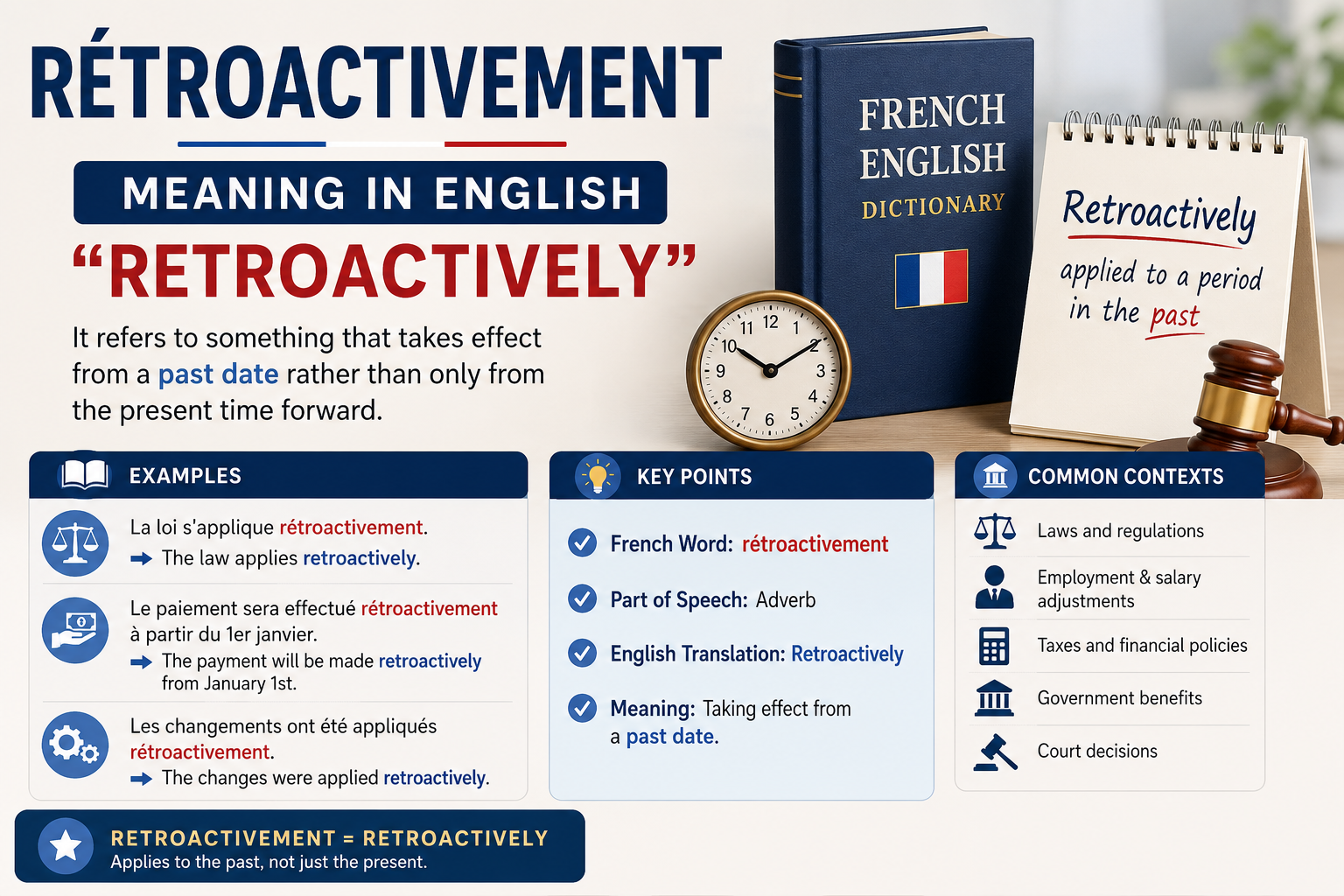
Retroactivement is a French adverb that translates to “retroactively” in English. It describes an action, law, decision, payment, or change that takes effect from a past date rather than only from the date it is announced or implemented.
Retroactivement Meaning in English
Many people encounter the French word retroactivement while reading legal documents, government notices, contracts, academic texts, or French-language news articles. Understanding its meaning is important because it often affects rights, obligations, payments, and regulations.
In English, retroactivement means retroactively.
Quick Answer Box
| French Word | English Translation | Part of Speech |
|---|---|---|
| Retroactivement | Retroactively | Adverb |
Pronunciation
French: rétroactivement
Approximate pronunciation:
ray-troh-ak-teev-mahn
What Does Retroactivement Mean?
The word refers to something that applies to a period in the past.
Instead of taking effect only from the present moment, a retroactive action changes circumstances beginning at an earlier date.
Simple Definition
Retroactivement = Retroactively = Taking effect from a past date.
This concept commonly appears in:
- Laws and regulations
- Employment contracts
- Tax policies
- Court decisions
- Salary adjustments
- Insurance claims
- Government benefits
How Retroactivement Works
When a rule or decision is applied retroactively, authorities treat it as though it had already been in effect from an earlier date.
Example
Imagine a company announces a salary increase on June 1.
Instead of starting on June 1, the company states that the increase applies retroactivement to January 1.
Employees receive back pay covering the months between January and June.
Common Examples of Retroactivement
Legal Context
French:
La loi s’applique rétroactivement.
English:
The law applies retroactively.
This means the law affects events that occurred before the law was officially enacted.
Employment Context
French:
L’augmentation salariale sera accordée rétroactivement.
English:
The salary increase will be granted retroactively.
Workers receive compensation for previous months.
Government Benefits
French:
Les prestations seront versées rétroactivement.
English:
Benefits will be paid retroactively.
Recipients may receive payments covering past eligible periods.
Tax Context
French:
Les modifications fiscales sont appliquées rétroactivement.
English:
The tax changes are applied retroactively.
Taxpayers may need adjustments to previous filings.
Retroactivement vs Immediately
Many learners confuse retroactive actions with immediate actions.
| Retroactively | Immediately |
|---|---|
| Applies to past dates | Applies from the current date |
| May create back payments | No effect on past periods |
| Common in legal and financial contexts | Common in everyday announcements |
| Revises earlier situations | Starts now |
Example
Immediate: A new policy starts today.
Retroactive: A new policy starts today but applies to actions taken six months ago.
Synonyms and Related Terms
Depending on context, words related to retroactivement include:
- Retroactively
- With retrospective effect
- Backdated
- Retrospectively
- Effective from an earlier date
- Applied to prior periods
These terms often appear in legal, administrative, and financial documents.
Why the Concept Is Important
The idea of retroactivity can have significant consequences.
Potential Benefits
- Corrects administrative delays
- Provides back pay to employees
- Ensures fairness in benefit programs
- Allows compensation for previous eligibility periods
Potential Challenges
- Creates legal disputes
- Increases administrative complexity
- May affect taxes and accounting records
- Can change previously settled situations
Because of these implications, courts and governments often apply retroactive measures carefully.
Retroactivement in Legal Systems
The concept is especially important in law.
Many legal systems distinguish between:
Retroactive Laws
Rules affecting events that occurred before enactment.
Prospective Laws
Rules affecting only future events.
In many countries, criminal laws generally cannot impose harsher penalties retroactively because of fairness and constitutional protections.
However, administrative, tax, employment, and benefits-related regulations may sometimes operate retroactively under specific conditions.
Common Situations Where You May See Retroactivement
You are likely to encounter the term in:
- Employment agreements
- Labor negotiations
- Government announcements
- Court judgments
- Insurance settlements
- Tax notices
- Social benefit programs
- Immigration decisions
- Pension adjustments
Understanding the term helps readers interpret exactly when a decision takes effect.
Key Takeaways
- Retroactivement is a French adverb.
- The English translation is retroactively.
- It means applying a rule, decision, payment, or change to a past date.
- The term commonly appears in legal, financial, employment, and government contexts.
- Retroactive actions can create back payments, revised obligations, or adjustments to earlier situations.
Conclusion
The French word retroactivement translates directly to retroactively in English. Whether it appears in legislation, employment contracts, tax regulations, or government programs, the term indicates that a decision or action affects a period before the official implementation date. Understanding this concept helps readers accurately interpret legal and financial documents and recognize when rights, obligations, or payments may apply to past events rather than only future ones.
5. FAQ Section
What is the English translation of retroactivement?
The English translation of retroactivement is retroactively.
Is retroactivement a legal term?
Yes. It is frequently used in legal, governmental, employment, and financial documents.
What does retroactively mean?
It means a rule, payment, or decision applies to a date in the past rather than beginning only from the current date.
Can salary increases be applied retroactivement?
Yes. Employers sometimes grant raises retroactively, resulting in back pay for employees.
Is retroactivement the same as retrospectively?
The two terms are closely related and often interchangeable, though legal contexts may distinguish between them depending on jurisdiction.
Where is retroactivement commonly used?
It commonly appears in:
Government benefit programs
Laws
Contracts
Tax notices
Court decisions
Pension adjustments







Post Comment