Plausiblement Meaning: Definition, Synonyms, Examples, and English Translation
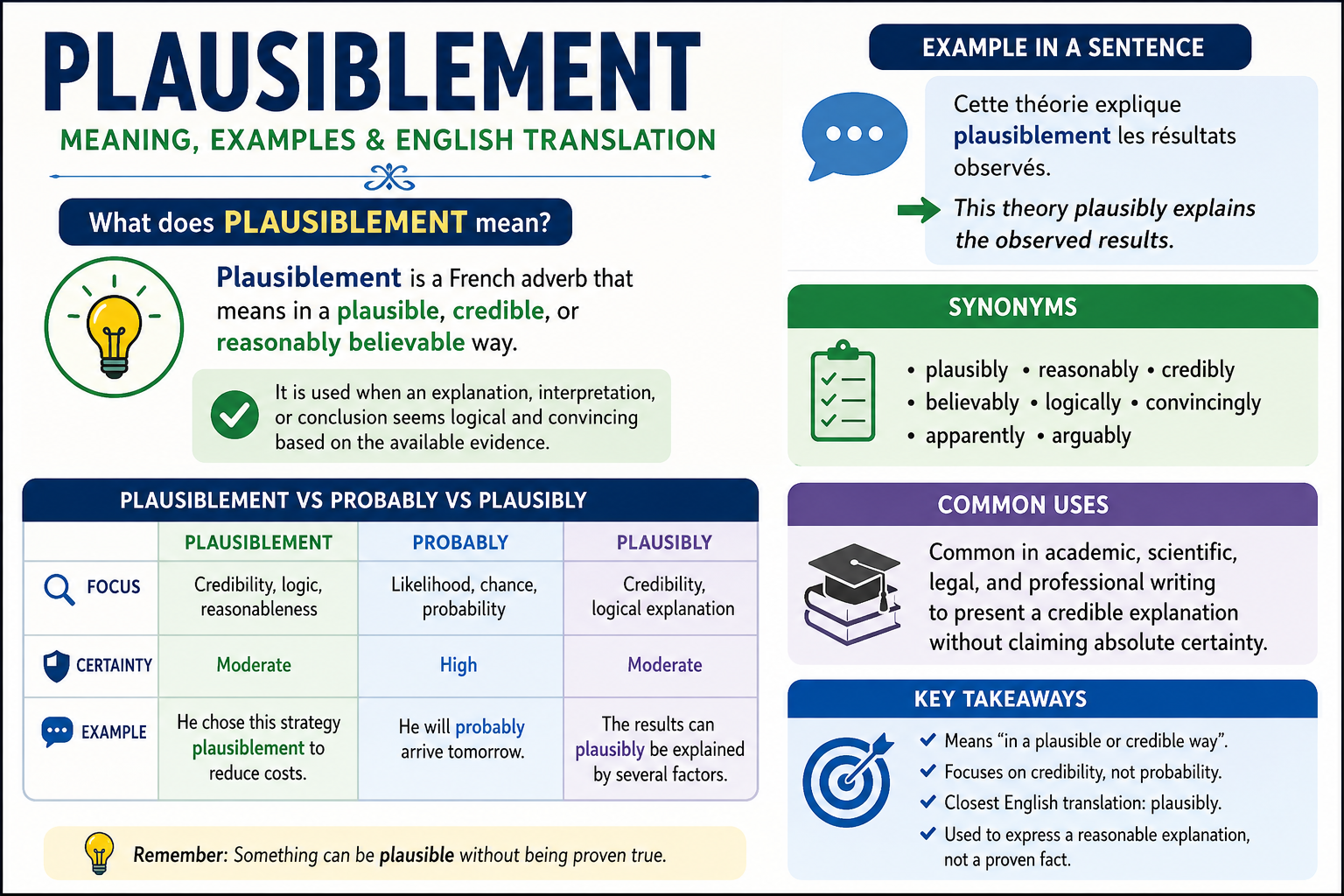
Table of Contents
- What Does Plausiblement Mean?
- Quick Answer
- Definition of Plausiblement
- English Translation
- Plausiblement vs Probably
- Plausiblement vs Plausibly
- Synonyms of Plausiblement
- Examples in Sentences
- Common Usage in Academic Writing
- Common Mistakes
- Key Takeaways
- FAQ
- Conclusion
Introduction
The French word plausiblement is commonly found in academic papers, legal documents, research articles, and formal writing. Many English speakers encounter the term while reading French texts and wonder whether it means probably, possibly, or plausibly.
Although these words are related, plausiblement has a specific meaning that focuses on credibility and logical reasoning rather than certainty. Understanding this nuance helps readers interpret French texts more accurately and choose the correct English translation.
Quick Answer
What Does Plausiblement Mean?
Plausiblement means:
In a plausible, credible, or reasonably believable way.
It describes an explanation, interpretation, or conclusion that appears logical and convincing based on available evidence.
Featured Snippet Answer
Plausiblement is a French adverb meaning plausibly, credibly, or reasonably. It is used when an explanation or assumption seems logical and believable, even if it has not been definitively proven. The closest English translation is usually plausibly rather than probably.
Definition of Plausiblement
The word comes from the French adjective plausible, meaning:
- Credible
- Reasonable
- Believable
- Convincing
- Logically acceptable
When used as an adverb, plausiblement describes how something can be understood, explained, interpreted, or assumed.
Example
Cette théorie explique plausiblement les résultats observés.
English:
This theory plausibly explains the observed results.
The theory appears credible and logically consistent.
English Translation of Plausiblement
Depending on context, plausiblement may translate as:
| French | English Translation |
|---|---|
| Plausiblement | Plausibly |
| Plausiblement | Credibly |
| Plausiblement | Reasonably |
| Plausiblement | Believably |
| Plausiblement | Probably (in some contexts) |
The most accurate translation is generally plausibly.
Plausiblement vs Probably
Many learners mistakenly treat these words as exact equivalents.
Plausiblement
Focuses on:
- Credibility
- Logic
- Reasonableness
Example:
He plausibly chose this strategy to reduce costs.
The explanation sounds logical.
Probably
Focuses on:
- Likelihood
- Probability
- Chance of being true
Example:
He will probably arrive tomorrow.
This indicates a strong expectation that the event will occur.
Comparison Table
| Word | Main Focus | Certainty Level |
| Plausibly | Credibility | Moderate |
| Probably | Probability | Higher |
| Possibly | Possibility | Lower |
| Certainly | Certainty | Very High |
Plausiblement vs Plausibly
In most cases, plausibly is the direct English equivalent.
French
Cette décision est plausiblement influencée par plusieurs facteurs.
English
This decision is plausibly influenced by several factors.
Both versions suggest a reasonable explanation without claiming certainty.
Synonyms of Plausiblement
Depending on context, similar words include:
- Plausibly
- Reasonably
- Credibly
- Believably
- Logically
- Convincingly
- Arguably
Near-synonyms:
- Probably
- Presumably
- Likely
- Apparently
These alternatives may change the meaning slightly.
Examples of Plausiblement in Sentences
Academic Context
The findings can plausibly be explained by environmental changes.
Business Context
The decline in sales is plausibly linked to inflation.
Legal Context
The court found that the proposed scenario was plausibly consistent with the available evidence.
Everyday Context
He plausibly forgot his phone at home.
Why Is Plausiblement Common in Academic Writing?
Researchers often use plausiblement because it allows them to:
- Present a hypothesis without overstating certainty.
- Acknowledge limitations in available evidence.
- Maintain scientific objectivity.
- Distinguish between facts and interpretations.
Example
Entrepreneurial decision-making is plausibly influenced by psychological and social factors.
The statement suggests a credible explanation rather than a proven fact.
Common Mistakes
Assuming Plausible Means True
A plausible explanation can still be incorrect.
Confusing Plausibility with Probability
Something may be plausible without being highly probable.
Overusing Probably
In many academic contexts, plausibly is more precise than probably.
Key Takeaways
- Plausiblement means “in a plausible or credible way.”
- The closest English translation is usually plausibly.
- It emphasizes logical credibility rather than statistical probability.
- The word is frequently used in academic, scientific, legal, and professional writing.
- A plausible explanation may be convincing without being proven.
FAQ
What does plausiblement mean in English?
The most accurate translation is plausibly, meaning in a credible, reasonable, or believable way.
Is plausiblement the same as probably?
No. Probably refers to likelihood, while plausiblement refers to credibility and logical consistency.
How do you pronounce plausiblement?
French pronunciation:
/plo-zee-bluh-mahn/
Is plausiblement commonly used in French?
Yes. It appears frequently in academic, legal, scientific, and formal writing.
What is the adjective form of plausiblement?
The adjective form is plausible.
Can plausiblement mean probably?
In certain contexts it may be translated as probably, but plausibly is usually more accurate.
Conclusion
Plausiblement is a French adverb meaning plausibly, credibly, or reasonably. It is used to describe explanations, interpretations, or conclusions that appear logical and believable based on available information. While it can sometimes resemble the meaning of probably, the term primarily emphasizes credibility rather than probability. Understanding this distinction helps readers interpret French texts more accurately and communicate with greater precision in both French and English.






Post Comment