Tatavel: The Story, Character, Shows, and Comedy Style of Sylvain Vanstaevel
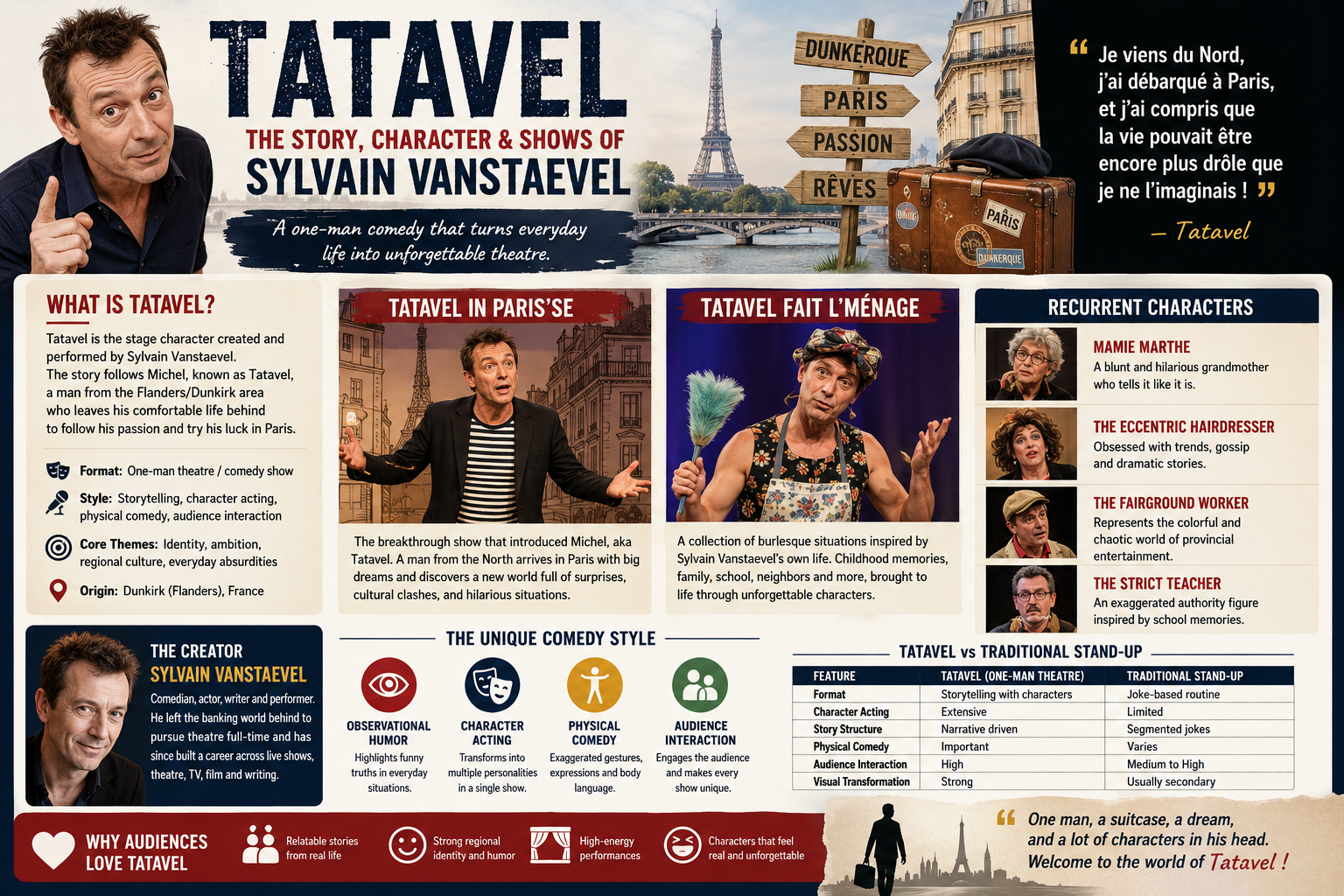
What Is Tatavel?
Tatavel is the stage identity associated with French comedian and actor Sylvain Vanstaevel, particularly through his one-man shows. The character is closely connected with Michel, a man from the Flanders/Dunkirk area whose story revolves around ambition, personal change, and the decision to pursue a passion for comedy.
The character became especially known through Tatavel in Paris’se, a one-man show written by Sylvain Vanstaevel and Katy Loock. Theatre archives describe Michel, nicknamed Tatavel, as a man born in the Flanders region who experiences an important turning point around his thirtieth birthday and decides to pursue his passion in Paris.
That detail matters because the character is not simply a collection of unrelated jokes. His comedy is built around a recognizable journey: leaving a familiar environment, entering an unfamiliar world, and discovering how strange ordinary life can become when viewed from a different perspective.
The core appeal comes from the combination of one-man theatre, character acting, storytelling, physical comedy, and observations about everyday life.
Who Created the Character?
The performer behind the character is Sylvain Vanstaevel, a French comedian and actor whose career has included one-man shows, theatre productions, television work, and film appearances.
Vanstaevel’s early connection with dance and theatre eventually led him away from his previous professional life and toward entertainment. A profile from Comédie Centrale states that he pursued his theatrical path in 2006–2007 and presented his first one-man show in Paris. That production was Tatavel in Paris’se.
The creative team around the original show also included Katy Loock, who is credited alongside Vanstaevel as a writer. Different productions of the show list different directors, including Isabelle Poirier and Katy Loock, reflecting its development across venues and runs.
This collaborative background helps explain why the production sits between conventional stand-up and theatre. The writing creates a central character, while the performer supplies the physical and vocal transformation needed to bring that world to life.
The Origins and Story Behind the Character
The character’s origins are strongly connected to Vanstaevel’s own professional and regional background.
Contemporary descriptions of the original show present its central figure as a banker from the Dunkirk area who decides to leave his established career path and follow his passion. A contemporary report described the premise as a banker leaving his Dunkirk homeland to try his luck in the capital.
This gives the comedy an important narrative engine.
The story naturally creates a series of contrasts:
- Security versus personal ambition
- Professional routine versus artistic freedom
- Regional familiarity versus Parisian culture
- Ordinary expectations versus unusual dreams
- Adult responsibility versus the desire to reinvent oneself
Rather than presenting these contrasts as serious social commentary alone, the performance turns them into comic situations.
The result is a character who feels more like a theatrical protagonist than a traditional stand-up narrator.
Tatavel in Paris’se: The Breakthrough Show
The first major production associated with the character was Tatavel in Paris’se. Theatre records show the show appearing in Paris from at least 2008 and continuing through several runs at the Petit Gymnase and other venues.
At the Théâtre du Gymnase, the production was scheduled in 2009 and 2010, with the 2010 run listed from January 18 through March 29. The production was presented as a one-person comedy show starring Vanstaevel and directed by Katy Loock.
The premise is simple but effective: a man from the North travels toward Paris with dreams of pursuing his passion.
Paris then becomes more than a setting. It becomes a source of cultural contrast.
The character encounters a new social environment and interprets it through his own regional perspective. That allows ordinary differences in behavior, language, expectations, and lifestyle to become sources of comedy.
Why the Original Show Worked
Several elements strengthened the production:
- A clear central character
- A recognizable personal journey
- Strong regional identity
- A contrast between Dunkirk and Paris
- Physical and theatrical performance
- Situational rather than purely punchline-based humor
- A story that develops over the course of the show
Contemporary listings also indicate that the show was performed repeatedly and became an important early part of Vanstaevel’s career. One 2011 report stated that the first one-man show had been performed nearly 200 times and that it had spent nine months at the Théâtre du Gymnase in Paris.
From the North of France to Paris
Regional identity is one of the most important elements in understanding the character.
The central figure comes from the Dunkirk/Flanders area of northern France. His movement toward Paris creates a classic comedy structure: someone leaves a familiar environment and enters a place governed by different social codes.
This does not require Paris or the North to be treated as completely opposite worlds. Instead, the humor comes from exaggerating the small differences that become noticeable when someone crosses a cultural or geographic boundary.
That approach has a long tradition in French comedy. Regional accents, habits, stereotypes, and social expectations can quickly establish a character and help an audience understand where that character comes from.
In this case, the northern identity gives the protagonist a clear point of view.
He is not an anonymous narrator. He is someone with a past, a home region, ambitions, and a reason for entering the theatrical world.
What Made the Character Stand Out?
The biggest distinction is the use of character-driven comedy.
A conventional stand-up performer may appear on stage primarily as themselves and move through a sequence of observations, stories, and punchlines. Vanstaevel’s work uses a broader theatrical vocabulary.
The performer can become different people, shift mannerisms, change voices, and construct comic situations around recognizable personalities.
This gives the audience two layers of entertainment:
- The situation itself is funny.
- The transformation of the performer into another character adds another source of humor.
That approach also makes the show more visual. Facial expressions, gestures, posture, timing, and vocal changes become part of the joke.
Comedy Style and Performance Techniques
The performance style combines several forms of live comedy.
Observational Comedy
Everyday situations provide much of the material.
Instead of depending entirely on unusual events, the comedy can begin with ordinary experiences such as family interactions, neighbors, work, school, social gatherings, or awkward encounters.
The humor comes from exaggerating what people recognize.
Character Acting
Character acting is central to the format. Vanstaevel does not need a large cast to create a collection of personalities because one performer can move between them.
This technique requires control over:
- Voice
- Facial expression
- Posture
- Timing
- Movement
- Accent or vocal identity
- Emotional intensity
Physical Comedy
Physical behavior can communicate a joke before a character says anything.
An exaggerated gesture, facial reaction, or change in posture can establish personality instantly.
This is especially useful in one-person theatre because physical transformation helps prevent the stage from feeling visually static.
Audience Connection
Descriptions of Vanstaevel’s performances repeatedly emphasize energy and exchanges with audiences. A 2012 review description characterized the show as fast-paced and highlighted its interaction with the public.
That interaction adds a live quality that cannot be fully reproduced by reading a written joke.
Major Themes in the Shows
The comedy is entertaining, but its recurring subjects give it additional depth.
Following a Passion
The original story is built around a major life decision: abandoning a conventional professional direction to pursue theatre.
That theme is broadly relatable.
Many people understand the tension between stability and personal ambition. The character simply explores that tension in a much more theatrical and exaggerated way.
Identity and Belonging
Moving from Dunkirk toward Paris creates questions about identity.
Who are you when you leave your familiar environment?
How do you behave when the social rules change?
How much of your original identity do you keep?
Comedy allows these questions to be explored without turning the performance into a lecture.
Everyday Absurdity
Another recurring idea is that ordinary life can be ridiculous when observed closely.
Family events, neighbors, workplaces, holidays, childhood memories, and social habits can all become comic material.
The ordinary becomes extraordinary through exaggeration.
Recurring Characters and Comic Personalities
Later productions expanded the range of personalities associated with Vanstaevel’s comedy.
Descriptions of Tatavel fait l’ménage mention several memorable characters, including Mamie Marthe, an eccentric hairdresser/choreographer, a fairground character, and an unconventional teacher.
These figures demonstrate an important development in the performance style.
The comedy is no longer dependent on a single protagonist’s journey. Instead, the performer can create an entire social universe.
Mamie Marthe
Mamie Marthe is presented as a particularly direct grandmother figure. Her bluntness creates a contrast with more restrained social behavior.
The Eccentric Hairdresser
The hairdresser character is built around exaggeration and theatrical personality. The concept itself is intentionally larger than everyday reality.
The Fairground Character
The fairground personality adds another layer of colorful regional and popular culture.
The Teacher
The teacher represents authority and childhood memories, allowing the performer to turn familiar school experiences into comic scenes.
The value of these characters is not simply that each has a different voice. Their personalities create different comic viewpoints.
Tatavel fait l’ménage and the Next Stage
After the original production, Vanstaevel continued developing the character and its theatrical universe.
Tatavel fait l’ménage became an important follow-up production. Theatre records show runs at the Petit Gymnase in 2012 and at Théâtre Le Bout in 2014.
The later show drew from Vanstaevel’s own experiences and placed them into burlesque situations. Descriptions mention childhood dance lessons, school memories, neighborhood life, holidays, and other personal experiences.
The evolution can be summarized like this:
| Aspect | In Paris’se | fait l’ménage |
|---|---|---|
| Central idea | Journey toward Paris | Wider collection of life experiences |
| Main setting | North of France and Paris | Everyday life and personal memories |
| Comedy engine | Culture shock and ambition | Character sketches and burlesque situations |
| Style | Character-driven storytelling | Broader gallery of personalities |
| Performance | One-man show | One-man show with multiple comic figures |
| Key appeal | Regional identity and reinvention | Everyday absurdity and character variety |
The second production therefore expanded the format rather than simply repeating the original premise.
How the Shows Compare With Traditional Stand-Up
The easiest way to understand the format is to see it as a hybrid.
| Feature | Character-based one-man theatre | Traditional stand-up |
| Main focus | Characters and narrative | Observations and punchlines |
| Acting | Extensive | Usually more limited |
| Physical performance | Important | Varies by performer |
| Story structure | Often central | Often segmented |
| Multiple personalities | Common | Less central |
| Audience interaction | Can be significant | Often significant |
| Visual transformation | Strong | Usually secondary |
This does not mean the two formats are opposites.
Modern stand-up can include characters, storytelling, impressions, physical comedy, and audience interaction. Likewise, one-man theatre can contain traditional joke structures.
The distinction is mainly one of emphasis.
Vanstaevel’s performances place considerable weight on acting and character transformation, making the experience closer to a compact theatrical production than a simple sequence of stand-up jokes.
Career Beyond the Character
Sylvain Vanstaevel’s career extends beyond the character that made his early one-man-show work recognizable.
Theatre archives list him in productions including L’Affaire de la rue de Lourcine, Mon mari est amnésique, and later solo work. His 2017 Théâtre du Gymnase production was described as a new show built around a gallery of colorful characters.
His agency profile also lists theatre, film, short-film, advertising, and writing work, including Tatavel in Pari’s and Tatavel fait le ménage.
His association with the North of France has also continued beyond entertainment. The Injeno association identifies Vanstaevel as a patron and describes his involvement with its Neurofête events in Dunkirk.
This broader career is important because it places the comedy character within a larger performing-arts career rather than treating it as Vanstaevel’s only work.
Why Audiences Connected With the Performances
The strongest reason is recognition.
Audiences do not need to understand an elaborate fictional universe before appreciating the material. The situations begin with things people already know: work, family, childhood, neighbors, ambition, embarrassment, and social expectations.
The second reason is emotional accessibility.
Even when a character is exaggerated, the motivation behind the character can remain human. Someone wants to be accepted. Someone wants to change careers. Someone worries about what others think. Someone tries to understand a new environment.
Comedy turns those familiar concerns into entertainment.
The third reason is performance energy.
Theatre archives and contemporary descriptions repeatedly emphasize Vanstaevel’s energy, character work, and ability to engage an audience.
What the Character Represents Today
Tatavel is best understood as a distinctive part of Sylvain Vanstaevel’s early and continuing theatrical identity rather than as a generic French comedy term.
Its importance comes from the combination of several ideas:
- Northern French identity
- Personal reinvention
- One-man theatre
- Character comedy
- Everyday observation
- Physical performance
- Social exaggeration
- Storytelling
The surviving theatre records also show that the work had a substantial performance history, including multiple Paris runs and later productions.
For someone discovering the name through search, the essential point is therefore straightforward: this is a stage persona and body of comedy work associated with Sylvain Vanstaevel, with Tatavel in Paris’se serving as the foundational production and Tatavel fait l’ménage expanding the character-based approach.
Suggested Image Alt Text
“Sylvain Vanstaevel performing as Tatavel in a French one-man comedy show”
FAQ
Who is Tatavel?
Tatavel is the stage identity associated with French comedian and actor Sylvain Vanstaevel. The character is connected especially with Michel, a man from the Dunkirk/Flanders area whose story forms the basis of the one-man show Tatavel in Paris’se.
Who created Tatavel?
Sylvain Vanstaevel created and performed the character. Katy Loock is also credited as a writer of Tatavel in Paris’se, while different productions involved different directors.
What is Tatavel in Paris’se about?
The show follows Michel, known as Tatavel, a man from the Flanders/Dunkirk area who decides to pursue his passion and heads toward Paris. The comedy uses this journey to explore ambition, regional identity, cultural differences, and everyday situations.
What is Tatavel fait l’ménage?
It is a later one-man comedy show by Sylvain Vanstaevel and Katy Loock. The production uses burlesque situations drawn from Vanstaevel’s life and features several recurring characters, including Mamie Marthe and an eccentric hairdresser.
Is the show traditional stand-up comedy?
It is better described as character-driven one-man theatre or one-man comedy. Although it shares elements with stand-up, the performances place greater emphasis on acting, physical transformation, recurring personalities, and narrative storytelling.
Conclusion
Tatavel remains an interesting example of how a comedian can turn personal experience, regional identity, and everyday observations into a theatrical character with a life of its own.
Sylvain Vanstaevel’s original In Paris’se established the central journey of a northern French man pursuing his passion in Paris, while later work such as Tatavel fait l’ménage broadened the format through autobiographical material and a larger gallery of comic personalities.
What makes the work distinctive is the balance between comedy and theatre. The humor does not depend only on isolated punchlines. It emerges from character, movement, storytelling, regional perspective, exaggeration, and recognizable human situations.
For readers researching the term today, understanding the performer, the original production, the later shows, and the theatrical techniques provides a much clearer picture than treating the name as a standalone comedy keyword.






Post Comment