IntegraTM Skin Regeneration Template: Complete Guide for Burn and Wound Reconstruction
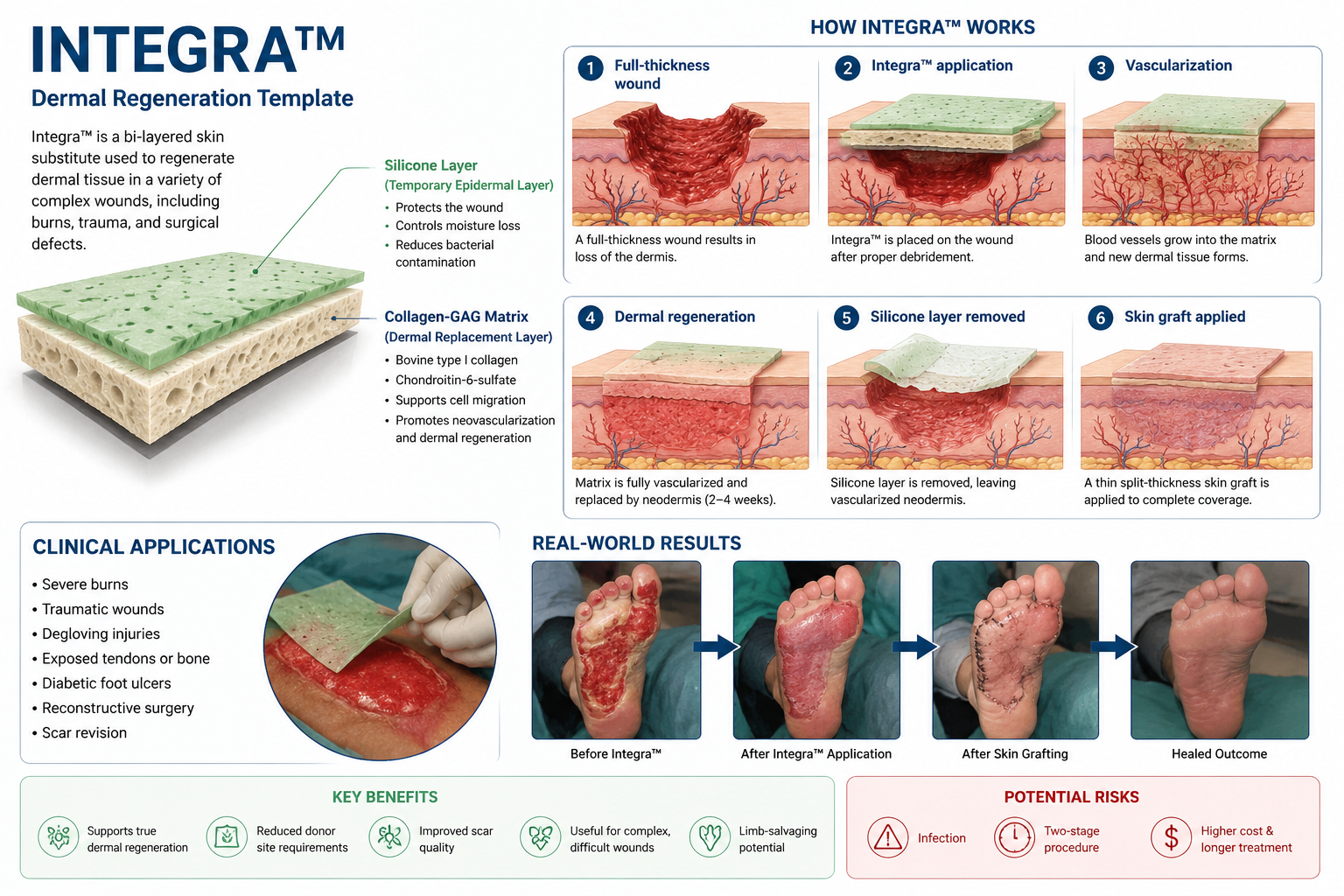
Table of Contents
- What Is IntegraTM?
- Quick Answer Box
- How IntegraTM Works
- Components of the IntegraTM Template
- Common Clinical Uses
- Benefits of IntegraTM
- Risks and Limitations
- IntegraTM vs Traditional Skin Grafts
- The IntegraTM Treatment Process
- Real-World Clinical Applications
- Who Is a Good Candidate?
- Recovery and Outcomes
- Expert Insights
- Frequently Asked Questions
- Conclusion
What Is IntegraTM?
IntegraTM is a bi-layer dermal regeneration template designed to replace damaged skin and support the growth of new dermal tissue. Surgeons commonly use it for severe burns, traumatic wounds, scar revisions, reconstructive procedures, and complex soft tissue defects.
Unlike traditional skin grafts that immediately cover a wound, IntegraTM first creates a scaffold that allows the patient’s own cells and blood vessels to grow into the wound bed. Once a new dermal layer forms, surgeons place a thin skin graft over the area to complete coverage.
Today, IntegraTM is widely used in burn centers and reconstructive surgery programs worldwide.
Quick Answer Box
What is IntegraTM?
IntegraTM is an artificial skin substitute made of a collagen-based dermal matrix covered by a temporary silicone layer. It helps regenerate dermal tissue in deep wounds, burns, and reconstructive defects before final skin grafting.
Main benefits:
- Reduces donor skin requirements
- Improves scar quality
- Supports dermal regeneration
- Useful for complex wounds
- Can help preserve limbs in difficult cases
How IntegraTM Works
IntegraTM functions as a temporary replacement for the missing dermis.
After wound preparation:
- The surgeon places IntegraTM over the wound.
- Blood vessels gradually grow into the collagen matrix.
- The matrix becomes populated with the patient’s cells.
- New dermal tissue develops.
- The silicone layer is removed after approximately 2–4 weeks.
- A thin split-thickness skin graft is applied.
The result is a reconstructed skin surface with improved tissue quality compared with many conventional approaches.
Components of the IntegraTM Template
IntegraTM contains two distinct layers.
1. Silicone Outer Layer
Functions include:
- Moisture control
- Protection from contamination
- Temporary epidermal replacement
- Reduced fluid loss
2. Collagen-Glycosaminoglycan Matrix
Made primarily from:
- Bovine Type I collagen
- Chondroitin-6-sulfate
Functions include:
- Cellular migration
- Angiogenesis
- Dermal regeneration
- Scar reduction
Common Clinical Uses
IntegraTM is used in multiple reconstructive scenarios.
Severe Burns
One of the most common indications involves:
- Full-thickness burns
- Deep partial-thickness burns
- Extensive burn injuries with limited donor skin
Traumatic Injuries
Including:
- Degloving injuries
- Crush injuries
- Exposed tendon wounds
- Exposed bone defects
Reconstructive Surgery
Surgeons may use IntegraTM for:
- Scar contractures
- Cancer reconstruction
- Soft tissue defects
- Complex hand reconstruction
Diabetic and Chronic Wounds
Selected patients with:
- Diabetic foot wounds
- Chronic ulcers
- Difficult lower extremity defects
may benefit when standard treatments are insufficient.
Benefits of IntegraTM
Improved Scar Quality
The regenerated dermal layer often produces more flexible and durable tissue.
Reduced Donor Site Requirements
Large burns can exhaust available donor skin.
IntegraTM reduces dependence on harvesting extensive skin grafts.
Immediate Availability
Unlike cadaveric skin, IntegraTM can be readily stocked and used when needed.
Coverage of Complex Wounds
Useful for wounds involving:
- Tendons
- Bone
- Joint surfaces
- Weight-bearing regions
Potential Limb Salvage
In selected patients, IntegraTM may help avoid amputation by facilitating reconstruction of difficult defects.
Risks and Limitations
No reconstructive option is perfect.
Potential disadvantages include:
Infection
The most common complication.
Infected matrices often require removal and replacement.
Two-Stage Procedure
Treatment generally requires:
- IntegraTM placement
- Subsequent skin grafting
This increases procedural complexity.
Higher Cost
Compared with conventional skin grafting alone.
Longer Healing Timeline
Patients must wait for vascularization before final grafting.
Patient Compliance
Success depends heavily on:
- Off-loading
- Wound care
- Blood sugar control
- Follow-up appointments
IntegraTM vs Traditional Skin Grafts
| Feature | IntegraTM | Traditional Skin Graft |
|---|---|---|
| Dermal regeneration | Yes | Limited |
| Donor skin required | Less | More |
| Number of procedures | Usually two | Often one |
| Scar quality | Often improved | Variable |
| Cost | Higher | Lower |
| Complex wound coverage | Excellent | More limited |
| Recovery complexity | Higher | Lower |
When IntegraTM May Be Preferred
- Extensive burns
- Limited donor sites
- Weight-bearing wounds
- Exposed tendon or bone
- Complex reconstructive cases
The IntegraTM Treatment Process
Step 1: Wound Assessment
The surgical team evaluates:
- Burn depth
- Tissue viability
- Infection risk
- Blood supply
Step 2: Debridement
All nonviable tissue is removed.
Step 3: IntegraTM Placement
The template is secured to the wound.
Step 4: Negative Pressure Wound Therapy
Many surgeons combine IntegraTM with wound vacuum therapy to:
- Improve adherence
- Reduce fluid accumulation
- Promote vascular ingrowth
Step 5: Vascularization
New blood vessels populate the matrix over several weeks.
Step 6: Skin Grafting
The silicone layer is removed and replaced with a thin split-thickness skin graft.
Real-World Clinical Applications
Clinical literature describes successful use of IntegraTM in:
- Extensive thermal burns
- Pediatric burns
- Hand reconstruction
- Lower-extremity salvage
- Diabetic foot reconstruction
- Plantar foot burns
Case reports have demonstrated that even high-risk patients with diabetes and peripheral vascular disease may achieve meaningful functional outcomes when carefully selected and closely monitored.
Who Is a Good Candidate?
Patients who may benefit include:
- Severe burn victims
- Individuals with limited donor skin availability
- Complex trauma patients
- Reconstructive surgery candidates
- Selected diabetic wound patients
Evaluation by a burn or reconstructive surgeon remains essential.
Recovery and Outcomes
Expected outcomes depend on:
- Wound size
- Infection control
- Blood supply
- Nutritional status
- Smoking history
- Diabetes management
Most successful cases demonstrate:
- Stable wound coverage
- Improved scar quality
- Functional tissue restoration
- Reduced contracture formation
Long-term monitoring remains important, especially for diabetic and weight-bearing wounds.
Expert Insights
IntegraTM has become one of the most influential advances in modern burn reconstruction because it addresses a major limitation of traditional skin grafting: the absence of a functional dermal layer.
The best outcomes occur when surgeons combine:
- Early wound excision
- Meticulous infection control
- Negative pressure wound therapy
- Appropriate patient selection
- Structured rehabilitation
For complex burns and reconstructive defects, the technology offers a valuable option when conventional treatments may not provide durable coverage.
Frequently Asked Questions
Is IntegraTM a skin graft?
No. IntegraTM is a dermal regeneration template that prepares the wound for later skin grafting.
How long does IntegraTM stay in place?
Typically 2–4 weeks before the silicone layer is removed and skin grafting occurs.
Can IntegraTM be used for diabetic wounds?
Yes. Surgeons sometimes use it for selected diabetic wounds and foot defects when conventional treatment options are insufficient.
Does IntegraTM reduce scarring?
Many studies report improved scar quality because it regenerates a dermal layer before grafting.
What is the biggest risk of IntegraTM?
Infection remains the most common complication.
Is negative pressure wound therapy necessary?
Not always, but many reconstructive surgeons use it because it can improve matrix incorporation and wound stability.
Conclusion
IntegraTM has transformed the management of complex burns and reconstructive wounds by providing a scaffold for true dermal regeneration. Although it requires careful patient selection, meticulous wound care, and a staged surgical approach, IntegraTM can improve scar quality, reduce donor-site demands, and offer limb-preserving solutions for difficult cases. For severe burns, traumatic injuries, and selected diabetic wounds, IntegraTM remains one of the most important biologic reconstruction technologies available in modern surgery.







Post Comment