Depleo: Meaning, Definition, Latin Conjugation, and Modern Usage Explained
Featured Snippet Answer
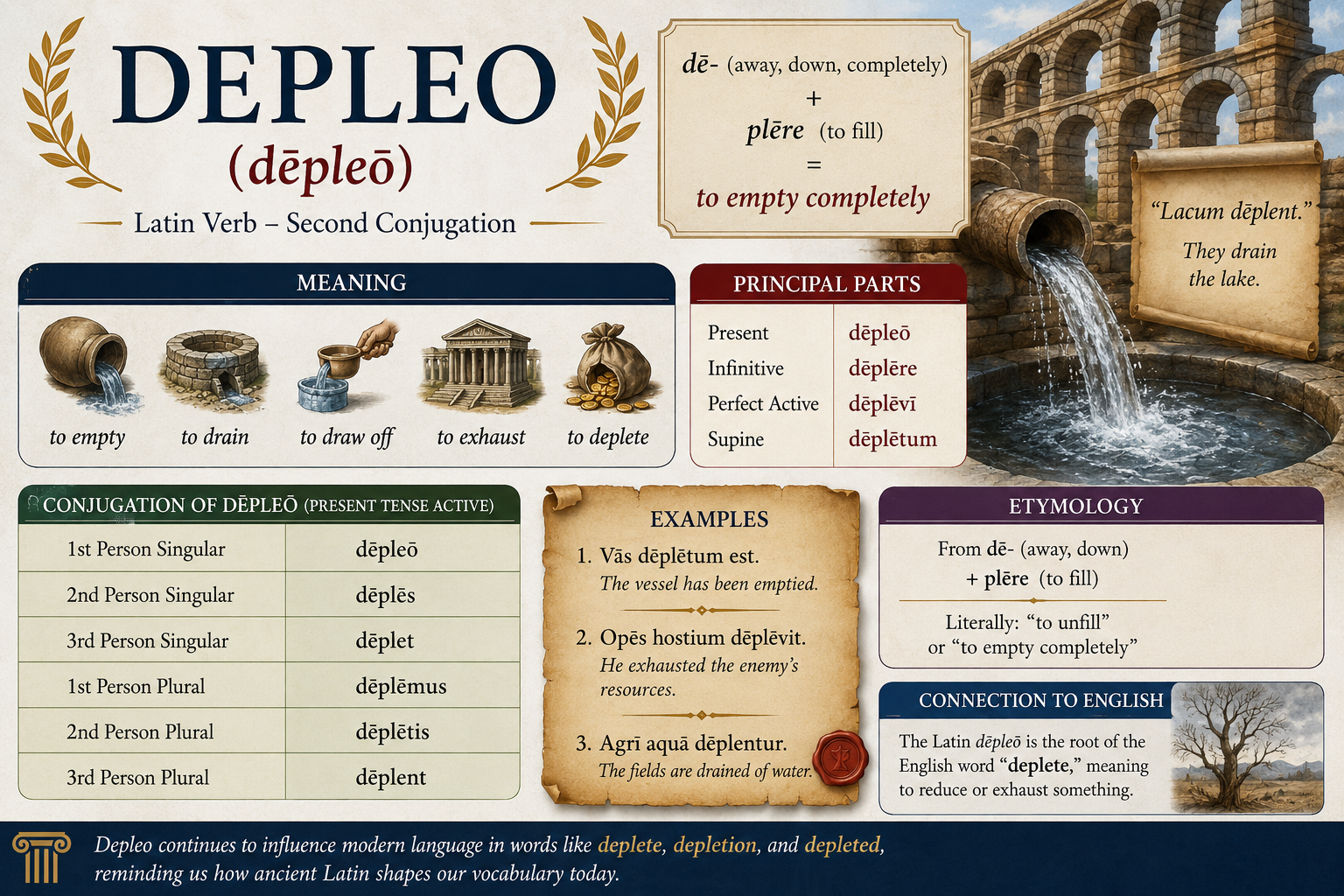
Depleo (Latin: dēpleō) is a second-conjugation Latin verb meaning to empty out, drain, draw off, exhaust, or deplete. It derives from the prefix dē- (“away” or “completely”) and plēre (“to fill”), creating the sense of removing contents until something is emptied.
Quick Answer Box
| Term | Details |
|---|---|
| Word | Depleo (dēpleō) |
| Language | Latin |
| Verb Type | Second Conjugation |
| Meaning | To empty, drain, exhaust, deplete |
| Infinitive | dēplēre |
| Perfect Active | dēplēvī |
| Supine | dēplētum |
| English Derivative | Deplete |
Table of Contents
- What Is Depleo?
- Meaning and Translation
- Latin Conjugation of Depleo
- Etymology and Word Origins
- How Depleo Was Used in Classical Latin
- Connection to the English Word “Deplete”
- Example Sentences
- Related Latin Terms
- Why Depleo Matters Today
- Conclusion
- FAQ
Introduction
The Latin verb depleo (dēpleō) is the linguistic ancestor of the English word deplete. Although it originated in ancient Latin texts, its meaning remains highly relevant today in discussions about resources, energy, finances, environmental sustainability, and even personal well-being.
Whether you’re studying Latin, researching etymology, translating classical texts, or exploring the roots of English vocabulary, understanding depleo provides valuable insight into how languages evolve over time.
What Is Depleo?
Depleo is a Latin verb that describes the action of removing contents from something until it becomes empty or significantly reduced.
The word conveys several closely related meanings:
- To empty out completely
- To drain
- To draw off liquid
- To exhaust resources
- To reduce substantially
- To deplete supplies
Unlike simple removal, depleo often implies a considerable or complete reduction.
Key Takeaway
The core idea behind depleo is taking away what once filled something.
Meaning and Translation
Depending on context, translators may render depleo as:
| Latin | English Translation |
|---|---|
| dēpleō | I empty |
| dēpleō | I drain |
| dēpleō | I exhaust |
| dēpleō | I deplete |
| dēpleō | I draw off |
Contextual Examples
- Draining a reservoir
- Emptying a container
- Exhausting a treasury
- Depleting military supplies
- Reducing natural resources
Because Latin relies heavily on context, the exact translation varies according to the object being affected.
Latin Conjugation of Depleo
Principal Parts
- dēpleō – I empty
- dēplēre – to empty
- dēplēvī – I emptied
- dēplētum – emptied
Present Tense
| Person | Form |
|---|---|
| I | dēpleō |
| You | dēplēs |
| He/She/It | dēplet |
| We | dēplēmus |
| You (Plural) | dēplētis |
| They | dēplent |
Imperfect Tense
| Person | Form |
|---|---|
| I | dēplēbam |
| You | dēplēbās |
| He/She/It | dēplēbat |
| We | dēplēbāmus |
| You (Plural) | dēplēbātis |
| They | dēplēbant |
As a second-conjugation verb, depleo follows the same pattern as many common Latin verbs ending in -ēre.
Etymology and Word Origins
The word consists of two elements:
Prefix: dē-
Meaning:
- Away
- Down
- Completely
Root: plēre
Meaning:
- To fill
Combined, these elements create a literal meaning of:
“to unfill” or “to empty completely.”
This construction influenced numerous later Romance and English vocabulary terms related to reduction and exhaustion.
How Depleo Was Used in Classical Latin
Ancient Latin authors used depleo in practical and figurative contexts.
Physical Use
Referring to:
- Emptying containers
- Draining water
- Removing stored goods
- Consuming supplies
Figurative Use
Referring to:
- Exhausting wealth
- Reducing armies
- Weakening resources
- Draining energy or strength
This dual usage mirrors modern English usage of “deplete.”
Connection to the English Word “Deplete”
One reason people search for depleo is its relationship to the English verb deplete.
Linguistic Development
Latin:
dēpleō
↓
Late Latin
↓
Old French influences
↓
English:
deplete
Today, the word appears in many fields:
Environmental Science
- Depleted groundwater
- Resource depletion
- Soil depletion
Economics
- Depleted reserves
- Depleted budgets
- Financial exhaustion
Health and Medicine
- Nutrient depletion
- Energy depletion
- Mineral deficiencies
The modern English term preserves the original Latin meaning remarkably well.
Example Sentences
Latin
Lacum dēplent.
Translation:
“They drain the lake.”
Latin
Opēs hostium dēplēvit.
Translation:
“He exhausted the enemy’s resources.”
Latin
Vās dēplētum est.
Translation:
“The vessel has been emptied.”
Related Latin Terms
Understanding depleo becomes easier when compared with related vocabulary.
| Word | Meaning |
|---|---|
| plēnus | Full |
| impleō | Fill up |
| repleō | Refill |
| complēō | Complete, fill completely |
| exhauriō | Drain, draw out |
| vacuō | Empty |
These terms belong to the broader semantic field of filling, emptying, and resource management.
Why Depleo Matters Today
Although depleo is an ancient Latin word, its influence extends into modern language, science, economics, and education.
Students encounter it when:
- Learning Latin
- Studying etymology
- Exploring classical literature
- Understanding English vocabulary roots
Professionals encounter its descendant, deplete, in discussions involving:
- Environmental conservation
- Resource management
- Healthcare
- Business strategy
- Sustainability
This makes depleo more than a historical curiosity—it remains part of an active linguistic legacy.
Conclusion
Depleo (dēpleō) is a second-conjugation Latin verb meaning to empty, drain, exhaust, or deplete. Derived from dē- and plēre, it expresses the idea of removing contents until something becomes empty or significantly reduced. Its direct connection to the English word deplete demonstrates how ancient Latin continues to shape modern vocabulary across science, economics, medicine, and everyday communication.
For students of Latin and language history, depleo serves as an excellent example of how classical roots remain alive in contemporary English.
FAQ
What does depleo mean in Latin?
Depleo means to empty out, drain, exhaust, draw off, or deplete.
Is depleo a second-conjugation verb?
Yes. Dēpleō belongs to the Latin second conjugation and has the infinitive form dēplēre.
What is the English equivalent of depleo?
The closest English equivalent is deplete.
What are the principal parts of depleo?
The principal parts are:
- dēpleō
- dēplēre
- dēplēvī
- dēplētum
Where does the word deplete come from?
The English word deplete ultimately derives from the Latin verb dēpleō.
Was depleo used literally or figuratively?
Both. Romans used it for physically emptying objects and figuratively exhausting resources, wealth, or strength.








Post Comment