Marronné Meaning in French: Definition, Usage, and Difference from Marron
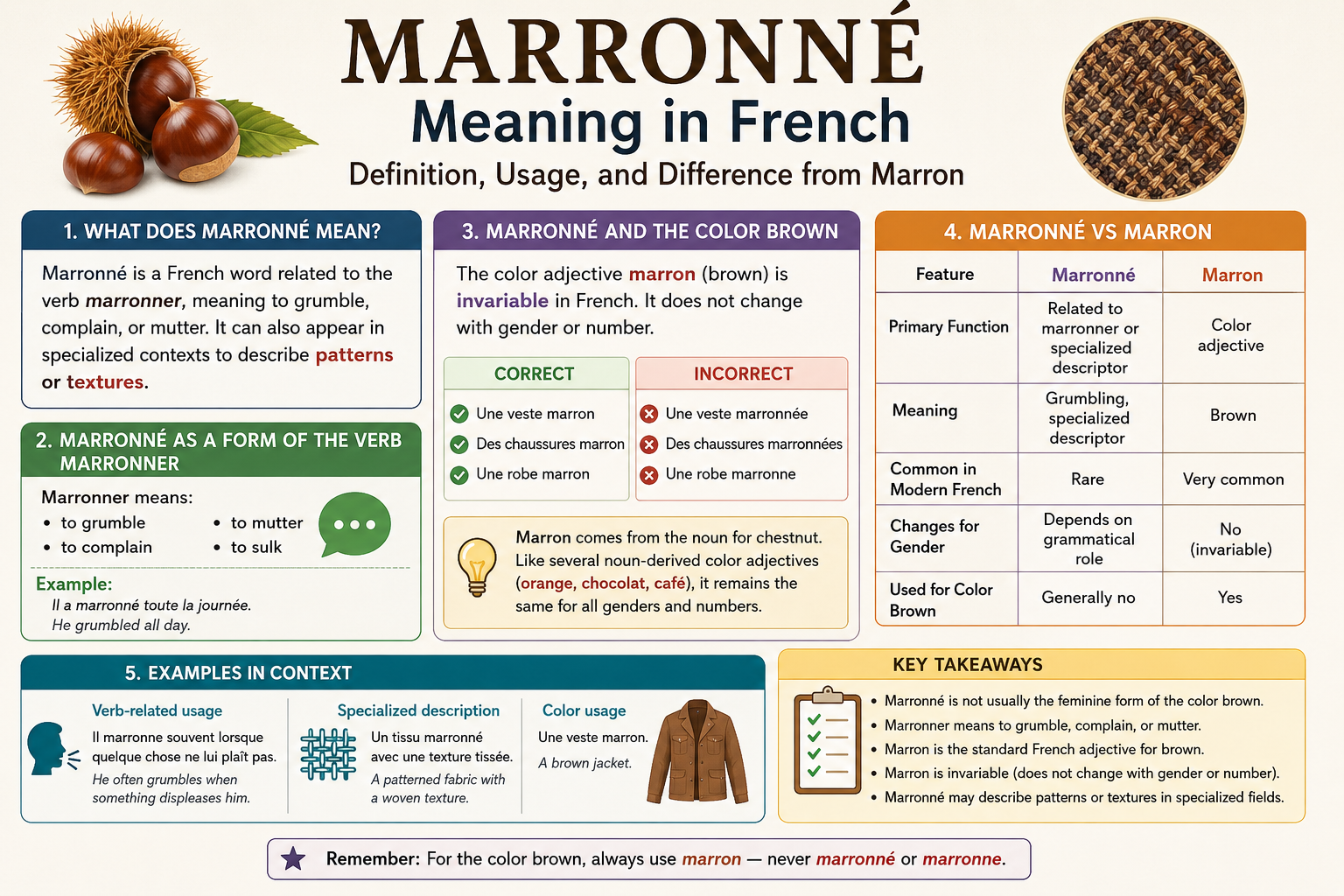
Featured Snippet Answer
Marronné is a French word that can function as a form of the verb marronner, meaning to grumble, complain, or mutter. It may also appear in specialized descriptive contexts for patterns or textures. However, it is generally not used as the feminine form of the color brown, because the French color adjective marron remains invariable.
Table of Contents
- What Does Marronné Mean?
- Quick Answer Box
- Marronné as a Form of the Verb Marronner
- Marronné and the French Color Brown
- Why Marron Does Not Change Form
- Specialized Uses of Marronné
- Common Examples
- Marronné vs Marron
- Key Takeaways
- Frequently Asked Questions
- Conclusion
Introduction
The French word marronné often creates confusion among learners because it resembles marron, the French word for “brown.” Many people assume that marronné is simply a gendered form of the color adjective. In reality, French grammar treats these words differently.
Understanding marronné requires looking at its connection to the verb marronner, its occasional descriptive uses, and the special grammatical rules surrounding the color adjective marron.
Quick Answer Box
| Term | Meaning | Common Usage |
|---|---|---|
| Marron | Brown (color) | Standard color adjective |
| Marronné | Related to marronner or specialized descriptive use | Less common |
| Marronne | Feminine singular form in certain grammatical contexts | Context-dependent |
| Marronner | To grumble, complain, mutter | Verb |
What Does Marronné Mean?
The meaning of marronné depends heavily on context.
In most cases, it is associated with:
- The verb marronner
- Expressions of grumbling or complaining
- Specialized descriptive language
- Certain texture or pattern descriptions
Unlike many French adjectives, marronné is not commonly used to indicate the color brown.
Marronné as a Form of the Verb Marronner
The verb marronner means:
- To grumble
- To complain under one’s breath
- To mutter dissatisfaction
- To sulk
When conjugated or transformed into participial forms, it can produce variants such as:
- marronné
- marronnée
- marronnés
- marronnées
Example
- Il a marronné toute la journée.
- He grumbled all day.
This usage is primarily verbal rather than color-related.
Marronné and the French Color Brown
One of the most common misconceptions involves color agreement.
Many learners expect French color adjectives to change according to gender and number.
Examples:
- Noir → noire
- Vert → verte
- Bleu → bleue
However, marron follows a different rule.
Correct
- Une veste marron
- Des chaussures marron
- Une robe marron
Incorrect
- Une veste marronnée
- Une robe marronne
When referring to the color brown, French speakers typically use the invariable adjective marron.
Why Marron Does Not Change Form
The word marron originally comes from the noun meaning “chestnut.”
French grammar generally treats color terms derived from nouns as invariable adjectives.
Examples include:
- Marron
- Orange
- Chocolat
- Café
Therefore:
- Un sac marron
- Une veste marron
- Des pantalons marron
The spelling remains unchanged regardless of gender or number.
Specialized Uses of Marronné
Although uncommon in everyday conversation, marronné may appear in specialized contexts.
These include:
Textile Descriptions
Certain woven fabrics use marronné to describe:
- Speckled patterns
- Mixed-color textures
- Decorative finishes
Design and Craftsmanship
The term may occasionally identify:
- Patterned surfaces
- Textured coatings
- Artistic finishes
In these contexts, marronné functions as a descriptive term rather than a standard color adjective.
Common Examples
Verb-Related Usage
- Il marronne souvent lorsque quelque chose ne lui plaît pas.
- He often grumbles when something displeases him.
Specialized Description
- Un tissu marronné avec une texture tissée.
- A patterned fabric with a woven texture.
Color Usage
- Une veste marron.
- A brown jacket.
This remains the preferred and grammatically correct form when describing color.
Marronné vs Marron
| Feature | Marronné | Marron |
| Primary Function | Related to marronner or descriptive use | Color adjective |
| Meaning | Grumbling, specialized descriptor | Brown |
| Common in Modern French | Rare | Very common |
| Changes for Gender | Depends on grammatical role | No |
| Used for Color Brown | Generally no | Yes |
Key Takeaways
- Marronné is not usually the feminine form of the color brown.
- The verb marronner means to grumble, complain, or mutter.
- Marron is the standard French adjective for brown.
- The color adjective marron remains invariable.
- Specialized industries may use marronné to describe textures or patterns.
- Context determines the correct interpretation of the word.
Frequently Asked Questions
What does marronné mean in French?
Marronné is generally associated with the verb marronner, meaning to grumble, complain, or mutter. It may also appear in specialized descriptive contexts.
Is marronné the feminine form of marron?
No. The color adjective marron is invariable and does not change form according to gender.
How do you say “brown jacket” in French?
The correct expression is:
Une veste marron
Not une veste marronnée.
What does marronner mean?
Marronner means to complain, grumble, mutter dissatisfaction, or sulk.
Why doesn’t marron change like other colors?
Because marron originates from a noun (“chestnut”), French grammar traditionally treats it as an invariable color adjective.
Is marronné commonly used in everyday French?
No. Most native speakers use marron when referring to the color brown. Marronné appears less frequently and is often context-specific.
Conclusion
The word marronné can refer to forms derived from the verb marronner or appear in specialized descriptive contexts, but it is rarely used to indicate the color brown. For color descriptions, standard French uses marron, an invariable adjective derived from the noun for chestnut. Understanding this distinction helps learners avoid one of the most common mistakes involving French color vocabulary and adjective agreement.








Post Comment