ncuentrase Meaning in Spanish: Definition, Grammar, and English Translation
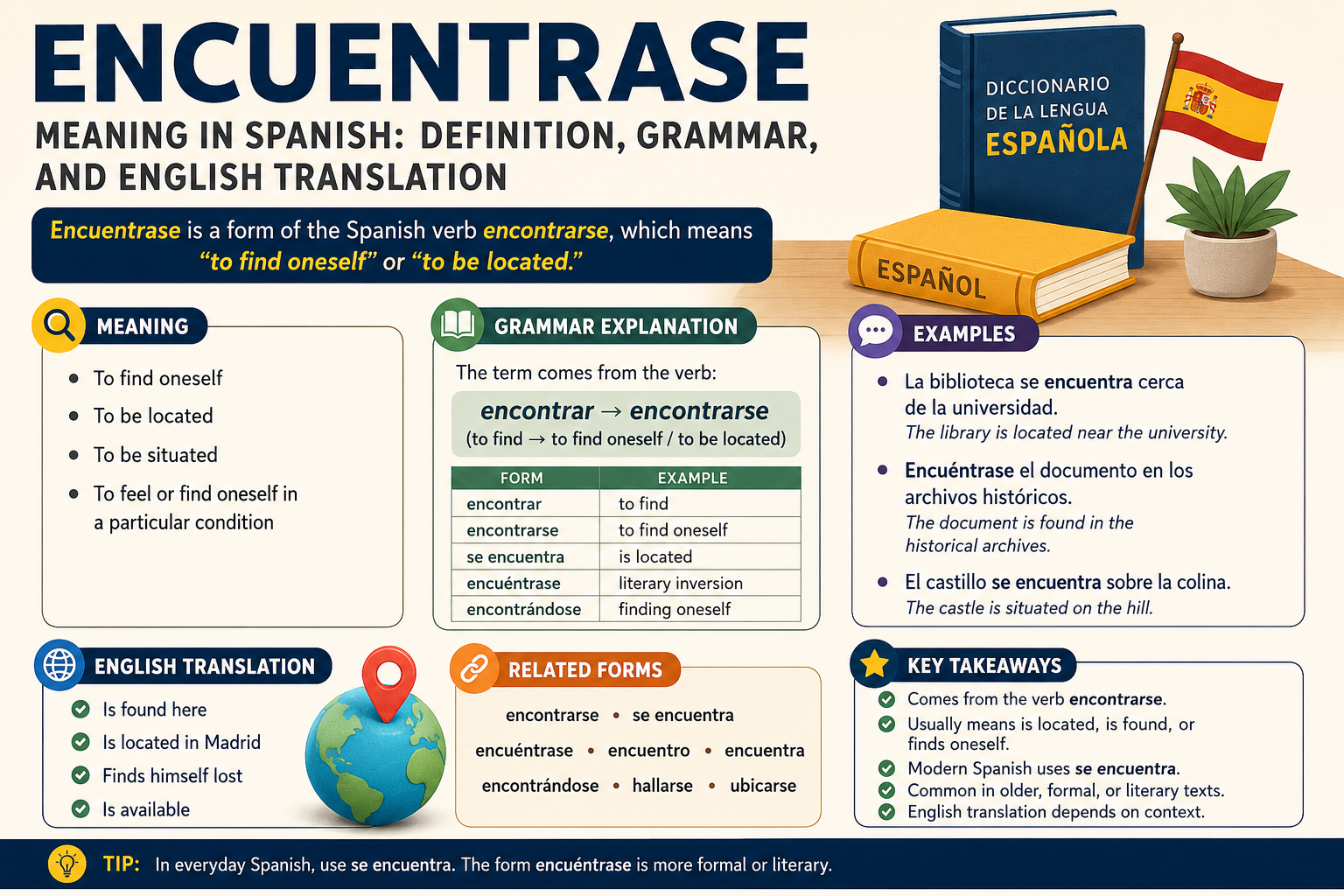
Table of Contents
- What Does Encuentrase Mean?
- Is Encuentrase a Correct Spanish Word?
- English Translation of Encuentrase
- Grammar Explanation
- Common Examples
- Related Spanish Forms
- Common Mistakes
- Key Takeaways
- Frequently Asked Questions
What Does Encuentrase Mean?
Encuentrase is an older or non-standard written form related to the Spanish verb encontrarse, which means:
- To find oneself
- To be located
- To be situated
- To feel or find oneself in a particular condition
In modern Spanish, the correctly accented form is generally written as encuéntrase in certain formal, literary, or archaic constructions.
Quick Answer Box
Encuentrase refers to a form of the verb encontrarse (“to find oneself” or “to be located”). In contemporary Spanish, it most commonly appears as encuéntrase in formal or literary texts and can translate into English as “is located,” “is found,” or “finds oneself.”
Is Encuentrase a Correct Spanish Word?
The form encuentrase may appear in:
- Historical documents
- Literary works
- Legal texts
- Older Spanish writing
Modern Spanish typically uses:
- se encuentra
- encuéntrase (formal inversion style)
For example:
- La iglesia se encuentra en el centro de la ciudad.
- “The church is located in the city center.”
Older style:
- Encuéntrase la iglesia en el centro de la ciudad.
Both convey essentially the same meaning.
English Translation of Encuentrase
Depending on context, encuentrase may translate as:
| Spanish | English Translation |
|---|---|
| Encuentrase aquí | Is found here |
| Encuéntrase en Madrid | Is located in Madrid |
| Encuéntrase perdido | Finds himself lost |
| Encuéntrase disponible | Is available |
The exact translation depends on the subject and sentence structure.
Grammar Explanation
The term comes from the Spanish verb:
Encontrar → Encontrarse
Meaning:
- To find
- To find oneself
- To be located
Verb Structure
| Form | Example |
| encontrar | to find |
| encontrarse | to find oneself |
| se encuentra | is located |
| encontrándose | finding oneself |
| encuéntrase | literary inversion |
Why Does It Look Unusual?
Spanish sometimes places the reflexive pronoun after the verb in literary constructions.
Example:
- Standard: Se encuentra en España.
- Literary: Encuéntrase en España.
Both mean:
“It is located in Spain.”
Common Examples
Example 1
La biblioteca se encuentra cerca de la universidad.
English:
“The library is located near the university.”
Example 2
Encuéntrase el documento en los archivos históricos.
English:
“The document is found in the historical archives.”
Example 3
El castillo se encuentra sobre la colina.
English:
“The castle is situated on the hill.”
Related Spanish Forms
Users searching for encuentrase may also be looking for:
- encontrarse
- se encuentra
- encuéntrase
- encuentro
- encuentra
- encontrándose
- hallarse
- ubicarse
These forms all relate to location, discovery, or condition.
Common Mistakes
Mistake 1: Assuming It Is a Separate Word
Encuentrase is not an independent vocabulary word. It is derived from the verb encontrarse.
Mistake 2: Confusing It With Encuentra
- Encuentra = finds
- Encuentrase / Encuéntrase = finds oneself / is located
Mistake 3: Using It in Everyday Conversation
Most native speakers today prefer:
- se encuentra
rather than
- encuéntrase
which sounds formal or literary.
Key Takeaways
- Encuentrase comes from the Spanish verb encontrarse.
- It usually means is located, is found, or finds oneself.
- Modern Spanish more commonly uses se encuentra.
- The form often appears in older, formal, or literary texts.
- English translations vary according to context.
FAQ Section
Is encuentrase a real Spanish word?
It appears in Spanish texts, but it is generally considered an older or literary form derived from encontrarse.
What is the English meaning of encuentrase?
Common translations include:
- is located
- is found
- finds oneself
What is the modern equivalent of encuentrase?
The modern and more common form is se encuentra.
Why do I see encuentrase in old books?
Older Spanish writing often used inverted verb-pronoun constructions that are less common today.
Is encuentrase used in everyday Spanish?
No. Most speakers use se encuentra instead.








Post Comment