How to Formulate a Dichotomous Question with Accompanying Instruction (With Examples)
Featured Snippet Answer
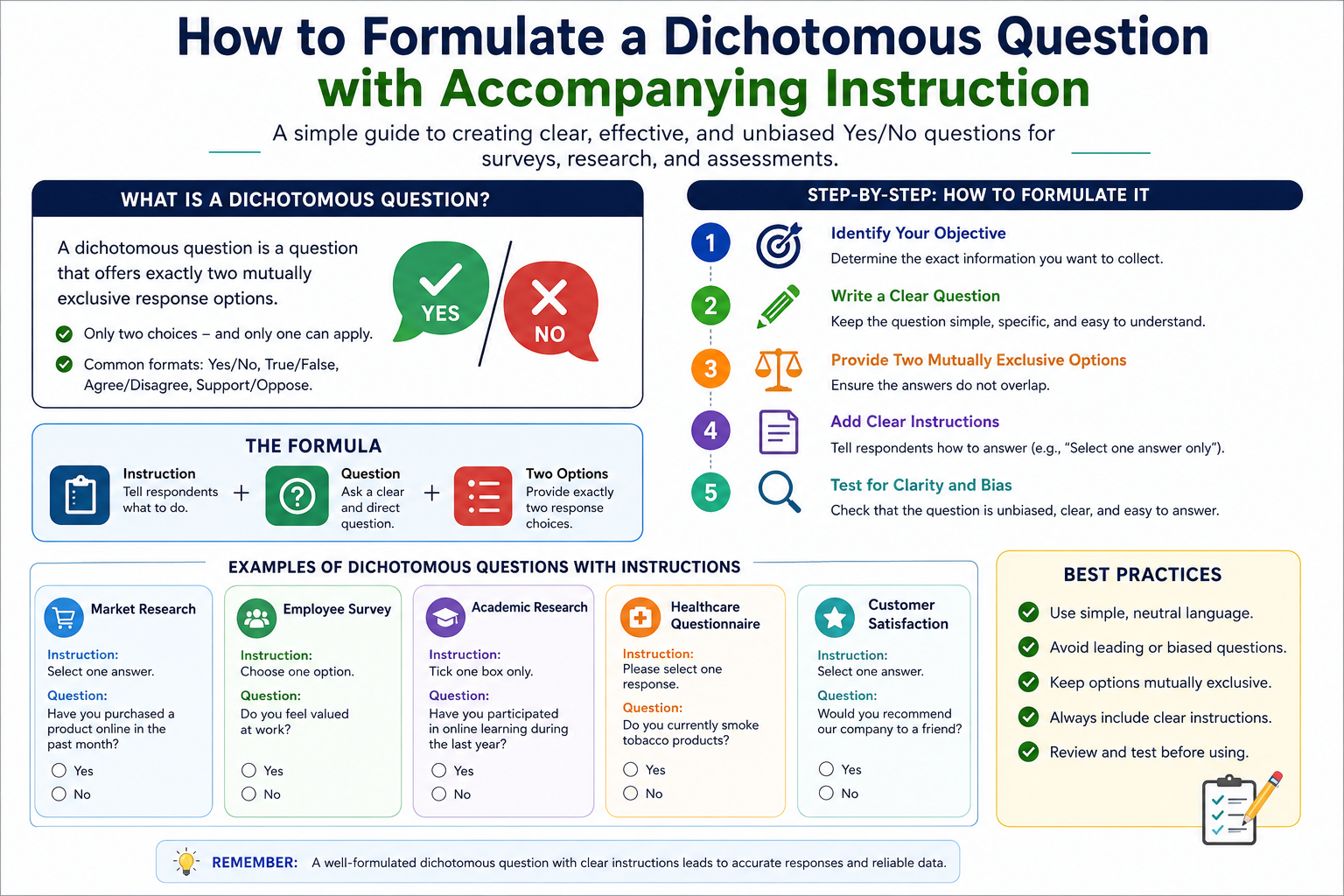
To formulate a dichotomous question with accompanying instruction, create a question that offers only two mutually exclusive response options, then provide clear instructions on how respondents should answer. Common formats include Yes/No, Agree/Disagree, True/False, or Support/Oppose choices.
Quick Answer Box
Formula:
Instruction: Select one answer only.
Question: [Ask the question]
Response Options:
- Option A
- Option B
Example:
Instruction: Choose one answer.
Question: Do you currently work remotely?
- Yes
- No
Table of Contents
- What Is a Dichotomous Question?
- Why Accompanying Instructions Matter
- How to Formulate a Dichotomous Question
- Step-by-Step Process
- Examples of Dichotomous Questions
- Common Mistakes to Avoid
- Best Practices for Surveys and Research
- Comparison with Other Question Types
- Key Takeaways
- FAQ
Introduction
Knowing how to formulate a dichotomous question with accompanying instruction is an essential skill in survey design, market research, academic studies, employee feedback collection, and customer satisfaction measurement.
A well-designed dichotomous question presents only two possible responses, making it easy for respondents to answer and researchers to analyze results. However, the question alone is not enough. Clear instructions ensure respondents understand exactly how they should respond.
What Is a Dichotomous Question?
A dichotomous question is a closed-ended question that provides exactly two possible answers.
Common examples include:
- Yes / No
- True / False
- Agree / Disagree
- Support / Oppose
- Pass / Fail
- Present / Absent
The term “dichotomous” comes from the idea of dividing something into two distinct categories.
Example
Question:
Do you own a smartphone?
- Yes
- No
Because respondents can select only one of two options, this is a dichotomous question.
Why Accompanying Instructions Matter
Instructions improve response quality by reducing confusion.
Without instructions:
❌ Respondents may select multiple answers.
❌ Respondents may misunderstand the purpose.
❌ Data quality may decline.
With instructions:
✅ Responses become consistent.
✅ Analysis becomes easier.
✅ Survey reliability improves.
Example
Instruction:
Select one answer only.
Question:
Have you purchased a product from our company within the last 12 months?
- Yes
- No
How to Formulate a Dichotomous Question
Step 1: Identify the Information Needed
Determine exactly what information you want to collect.
Example objective:
Determine whether customers have used a service.
Step 2: Create a Clear Question
Keep wording simple and direct.
Good:
“Have you used our mobile application?”
Poor:
“Considering all circumstances, have you ever potentially interacted with our mobile solution?”
Step 3: Provide Two Mutually Exclusive Options
The answers should not overlap.
Example:
- Yes
- No
Step 4: Add Clear Instructions
Tell respondents how to answer.
Examples:
- Select one answer only.
- Choose the option that best applies.
- Mark either Yes or No.
- Tick one box only.
Step 5: Test for Clarity
Ask yourself:
- Can respondents easily understand it?
- Can only one answer be selected?
- Is the wording unbiased?
Step-by-Step Template
Use this simple structure:
Template 1
Instruction:
Select one answer only.
Question:
[Insert Question]
Options:
- Yes
- No
Template 2
Instruction:
Choose the statement that best reflects your opinion.
Question:
Do you agree that remote work increases productivity?
- Agree
- Disagree
Template 3
Instruction:
Mark one option.
Question:
Have you completed the training program?
- Completed
- Not Completed
Examples of Dichotomous Questions
Customer Satisfaction Survey
Instruction:
Select one answer.
Question:
Would you recommend our company to a friend?
- Yes
- No
Employee Survey
Instruction:
Choose one option.
Question:
Do you feel valued at work?
- Yes
- No
Academic Research
Instruction:
Tick one box only.
Question:
Have you participated in online learning during the last year?
- Yes
- No
Healthcare Questionnaire
Instruction:
Please select one response.
Question:
Do you currently smoke tobacco products?
- Yes
- No
Market Research
Instruction:
Select the option that applies to you.
Question:
Have you purchased a product online in the past month?
- Yes
- No
Common Mistakes to Avoid
Leading Questions
Avoid:
“Don’t you agree that our service is excellent?”
Use:
“Are you satisfied with our service?”
Double-Barreled Questions
Avoid:
“Do you like our pricing and customer support?”
This asks two things at once.
Use separate questions instead.
Ambiguous Wording
Avoid:
“Do you frequently use social media?”
The word “frequently” means different things to different people.
Use:
“Do you use social media daily?”
Missing Instructions
Never assume respondents know what to do.
Always include a brief instruction.
Comparison: Dichotomous vs Other Question Types
| Question Type | Number of Responses | Example |
|---|---|---|
| Dichotomous | 2 | Yes / No |
| Multiple Choice | 3+ | Choose one option |
| Rating Scale | Usually 5–10 | Satisfaction scale |
| Likert Scale | 5–7 levels | Strongly Agree to Strongly Disagree |
| Open-Ended | Unlimited | Written response |
Dichotomous questions are ideal when researchers need clear, binary data.
Best Practices for Surveys and Research
Keep Questions Neutral
Avoid influencing responses.
Use Simple Language
Write for the average respondent.
Provide Explicit Instructions
Tell participants exactly what to do.
Ensure Mutual Exclusivity
Only one answer should be correct or applicable.
Match Questions to Research Goals
Use dichotomous questions when a binary response is sufficient.
Expert Tip
Survey researchers often combine dichotomous questions with follow-up questions.
Example:
Question 1
Have you used our software before?
- Yes
- No
If Yes:
Question 2
How satisfied were you with the software?
This approach improves data quality while keeping surveys concise.
Key Takeaways
- A dichotomous question offers only two response options.
- Common formats include Yes/No and Agree/Disagree.
- Clear accompanying instructions improve response accuracy.
- Questions should be simple, unbiased, and mutually exclusive.
- Dichotomous questions are widely used in surveys, research, healthcare, education, and market analysis.
Conclusion
Understanding how to formulate a dichotomous question with accompanying instruction is fundamental to effective survey and questionnaire design. The process is straightforward: write a clear question, provide exactly two mutually exclusive response options, and include concise instructions telling respondents how to answer. When designed correctly, dichotomous questions generate reliable, easy-to-analyze data and improve the overall quality of research findings.
5. FAQ Section
What is a dichotomous question?
A dichotomous question is a closed-ended question that allows only two possible responses, such as Yes/No or Agree/Disagree.
Why should a dichotomous question include instructions?
Instructions help respondents understand how to answer, reducing confusion and improving data quality.
What are examples of dichotomous questions?
Examples include:
- Do you own a car? (Yes/No)
- Have you used our service before? (Yes/No)
- Do you agree with this statement? (Agree/Disagree)
When should I use dichotomous questions?
Use them when you need a simple binary response and do not require detailed explanations.
What is the biggest mistake when creating dichotomous questions?
Using biased, confusing, or double-barreled wording that prevents respondents from giving a clear answer.







Post Comment