Napelos: Meaning, Plant Identification, and Safety Facts
Quick Answer
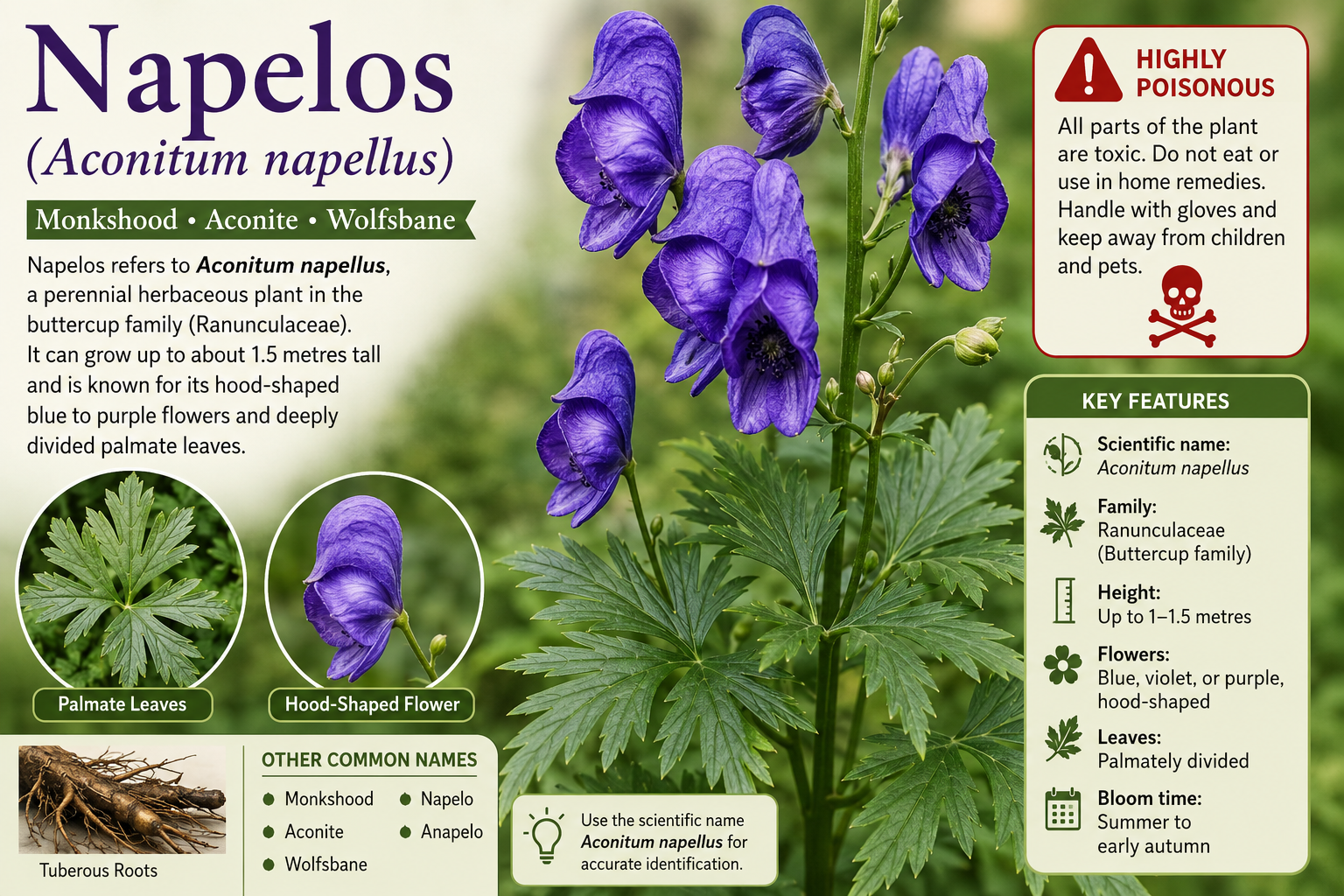
Napelos is a term associated with Aconitum napellus, a perennial flowering plant in the buttercup family (Ranunculaceae). More commonly called monkshood, aconite, or wolfsbane, it can grow to about 1.5 metres tall, has deeply divided palmate leaves, and produces hood-shaped blue to purple flowers. Every part of the plant is highly toxic.
Table of Contents
- What Is Napelos?
- Napelos Plant Features
- Other Names for Napelos
- Is Napelos Poisonous?
- Napelos vs. Monkshood vs. Aconite
- Can You Grow Napelos?
- Frequently Asked Questions
- Conclusion
What Is Napelos?
Napelos refers to the plant Aconitum napellus, a herbaceous perennial in the buttercup family. The name appears to be a variant or misspelling connected to napelo, napellus, and related botanical names.
The plant is native to mountainous parts of Europe and is known for its striking flowers. Its upper flower sepal forms a helmet-like shape, which explains the common name monkshood.
Important: Napelos is not an edible or casual medicinal herb. It contains potent toxic alkaloids, including aconitine.
Napelos Plant Features
You can identify napelos by several distinctive traits:
- Scientific name: Aconitum napellus
- Plant family: Ranunculaceae, the buttercup family
- Growth habit: Perennial herb
- Typical height: Up to about 1–1.5 metres
- Leaves: Palmately divided or lobed leaves
- Flowers: Blue, violet, purple, or occasionally pale hood-shaped blooms
- Flowering season: Usually summer to early autumn
- Roots: Thickened, tuber-like roots
The flower shape is the most recognisable feature. It resembles a small hood or helmet rather than the open, flat flower form people often associate with buttercups.
Other Names for Napelos
Depending on language and region, napelos may be connected with these names:
| Name | Meaning or usage |
|---|---|
| Aconitum napellus | Accepted scientific name |
| Monkshood | Refers to the hood-like flower |
| Aconite | Common English botanical name |
| Wolfsbane | Historic common name |
| Napelo | Spanish and Portuguese common-name variant |
| Anapelo | Another Iberian-language common name |
Using the scientific name is the safest way to avoid confusion, because common names can refer to multiple Aconitum species.
Is Napelos Poisonous?
Yes. Napelos is extremely poisonous. The plant contains alkaloids that can affect the nervous system and heart. Poisoning can occur after ingestion, and handling plant material may also create risk, especially if sap reaches broken skin or the eyes.
Safety guidance
- Do not eat any part of the plant.
- Do not make home remedies, teas, tinctures, or extracts from it.
- Keep it away from children and pets.
- Wear gloves when planting, pruning, or removing it.
- Wash hands and gardening tools after contact.
- Seek urgent medical help or contact local poison-control services if ingestion is suspected.
Traditional references to aconite should not be treated as evidence that it is safe for self-treatment. The gap between a toxic and potentially dangerous exposure can be very small.
Napelos vs. Monkshood vs. Aconite
These terms usually point to the same plant or closely related plants in the Aconitum genus.
| Term | What it usually means |
| Napelos | A variant connected to Aconitum napellus |
| Monkshood | Common name for Aconitum species, especially A. napellus |
| Aconite | Broad common name for Aconitum |
| Wolfsbane | Historic common name for aconite/monkshood |
| Aconitum napellus | Precise scientific name for common monkshood |
For an accurate plant label, use: Napelos (Aconitum napellus).
Can You Grow Napelos?
Gardeners sometimes grow Aconitum napellus for ornamental flowers, but it is not a low-risk plant for every garden.
Consider it only if you can manage it responsibly:
- Plant it away from vegetable beds, play areas, and pet-accessible spaces.
- Label it clearly with its scientific name and toxicity warning.
- Wear gloves for all handling.
- Do not compost unidentified plant material where children or animals may access it.
- Avoid planting it where visitors may mistake it for an edible or medicinal herb.
Its visual appeal does not outweigh safety concerns in households with young children, curious pets, or frequent garden visitors.
Key Takeaways
- Napelos refers to Aconitum napellus, commonly called monkshood or aconite.
- It is a tall perennial buttercup-family plant with palmate leaves and hood-shaped flowers.
- The scientific name is more precise than common-name variants.
- Napelos is highly poisonous and should never be used as a home remedy or food.
- If grown ornamentally, it requires clear labelling and careful handling.
Frequently Asked Questions
What does napelos mean?
Napelos is a botanical term associated with Aconitum napellus, a poisonous perennial flowering plant also known as monkshood, aconite, or wolfsbane.
Is napelos the same as monkshood?
Usually, yes. Monkshood is one of the most common English names for Aconitum napellus, the plant linked to napelos.
What family does napelos belong to?
Napelos belongs to the buttercup family, Ranunculaceae.
What does a napelos plant look like?
It has tall stems, palmately divided leaves, and distinctive blue-to-purple flowers shaped like hoods or helmets.
Is napelos safe to touch?
Avoid direct contact. Wear gloves when handling the plant and wash hands afterward. Never ingest it or use it in homemade preparations.
Is napelos used in medicine?
Aconite has a history of traditional use, but it is highly toxic. Do not use napelos for self-medication.
Conclusion
Napelos is best understood as a name connected to Aconitum napellus, the striking but highly poisonous plant known as monkshood or aconite. For identification, safety, and publishing accuracy, use the scientific name alongside the common term: Napelos (Aconitum napellus).








Post Comment