Viagé Explained: How the French Viager Property System Works
Featured Snippet Answer
Viagé, commonly associated with the French term viager, is a real-estate arrangement in which a buyer purchases a property while allowing the seller to remain in the home for life. The buyer typically pays an upfront amount and ongoing payments, gaining full possession when the seller’s occupancy rights end.
Table of Contents
- What Is Viagé?
- How a Viagé Transaction Works
- Key Components of a Viager Sale
- Benefits of Viagé
- Risks and Drawbacks
- Viagé vs Traditional Property Purchase
- Who Uses Viagé?
- Practical Example
- Expert Considerations
- Key Takeaways
- Frequently Asked Questions
- Conclusion
What Is Viagé?
Viagé generally refers to the French real-estate concept known as viager. It is a property transaction where the seller, often an older homeowner, sells a property while retaining the right to live there for life.
Unlike a conventional home sale, the buyer does not usually gain immediate occupancy. Instead, the seller receives:
- A lump-sum payment
- Ongoing periodic payments
- Continued housing security
This arrangement has existed in France for centuries and remains a niche investment strategy today.
Quick Answer Box
What does viagé mean?
Viagé refers to a life-annuity property sale, typically known as a viager transaction in France, where a buyer purchases real estate while the seller continues living in the property and receives regular payments.
How a Viagé Transaction Works
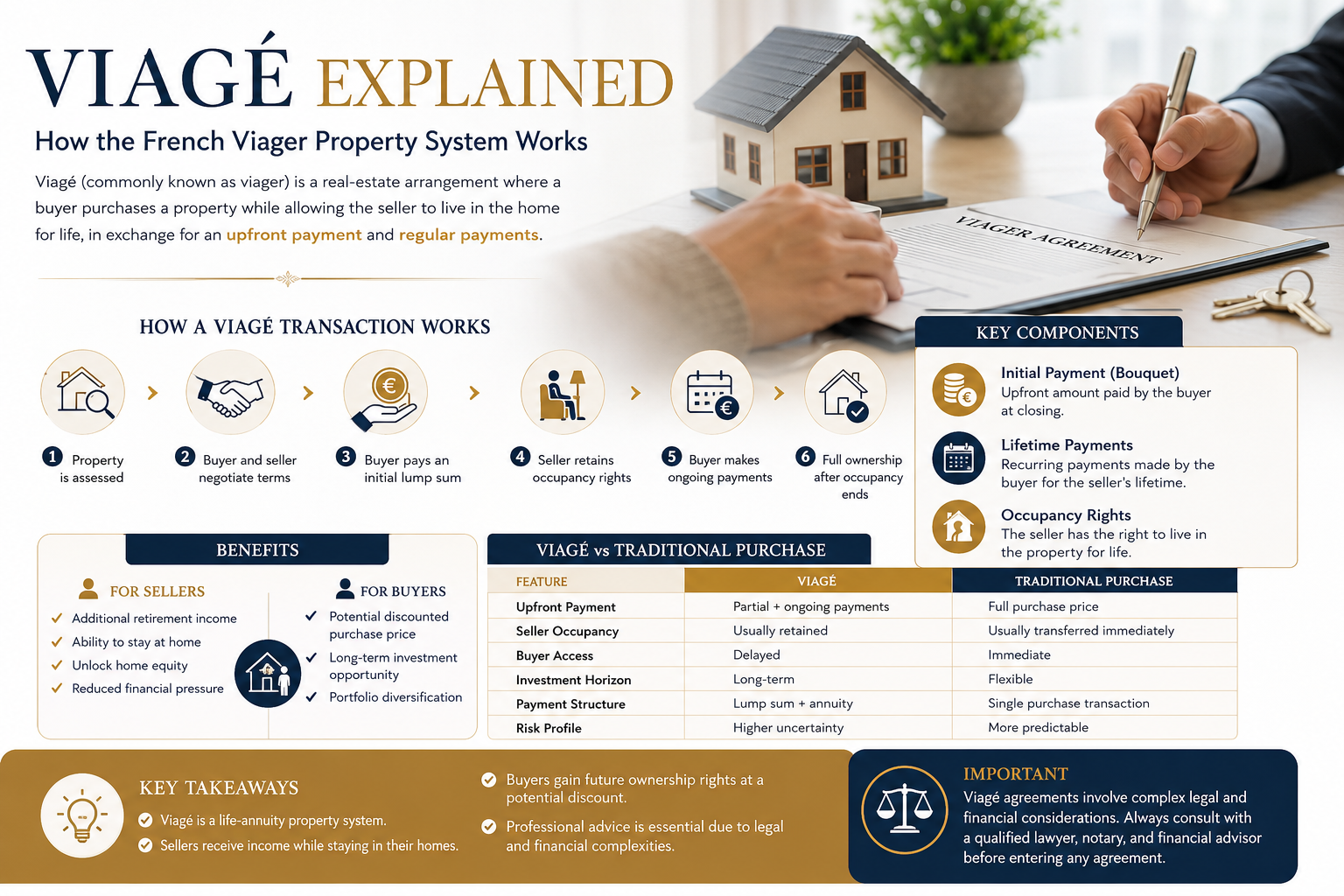
A typical viagé agreement follows these steps:
- Property value is assessed.
- Buyer and seller negotiate terms.
- Buyer pays an initial lump sum.
- Seller retains occupancy rights.
- Buyer makes ongoing monthly or annual payments.
- Full ownership rights become available after the seller’s occupancy ends.
The exact structure depends on local laws, property value, seller age, and negotiated conditions.
Key Components of a Viager Sale
Initial Payment (Bouquet)
The bouquet is the upfront payment made by the buyer at closing.
Its size varies depending on:
- Property value
- Seller age
- Occupancy arrangements
- Negotiated terms
Lifetime Payments
The buyer agrees to make recurring payments to the seller.
Payments often continue for the remainder of the seller’s life.
Occupancy Rights
Most viager agreements allow the seller to remain in the property.
This occupancy right is a defining characteristic of the arrangement.
Benefits of Viagé
For Sellers
Additional Retirement Income
Regular payments can supplement retirement income.
Ability to Stay at Home
Sellers maintain their familiar living environment.
Reduced Financial Pressure
The arrangement can unlock property equity without requiring relocation.
For Buyers
Potential Discounted Purchase Price
Properties are often acquired below full market value.
Long-Term Investment Opportunity
Investors may benefit from future appreciation.
Portfolio Diversification
Viager properties offer an alternative to traditional real-estate investments.
Risks and Drawbacks
For Buyers
- Uncertain investment timeline
- Ongoing payment obligations
- Limited immediate use of the property
- Complex legal considerations
For Sellers
- Dependence on buyer reliability
- Potential disputes over contract terms
- Market value may increase beyond expectations
Understanding these risks is essential before entering any viagé arrangement.
Viagé vs Traditional Property Purchase
| Feature | Viagé | Traditional Purchase |
|---|---|---|
| Upfront Payment | Partial + ongoing payments | Full purchase price |
| Seller Occupancy | Usually retained | Usually transferred immediately |
| Buyer Access | Delayed | Immediate |
| Investment Horizon | Long-term | Flexible |
| Payment Structure | Lump sum + annuity | Single purchase transaction |
| Risk Profile | Higher uncertainty | More predictable |
Who Uses Viagé?
Viagé arrangements are most commonly used by:
- Retirees seeking supplemental income
- Older homeowners wanting to remain in their homes
- Long-term real-estate investors
- Buyers seeking discounted acquisition opportunities
- Estate-planning participants
Practical Example
Imagine a property valued at €300,000.
The buyer agrees to:
- Pay €90,000 upfront
- Provide monthly payments to the seller
- Allow the seller to continue living in the home
The seller receives financial support while remaining in the property. The buyer gains a future ownership interest at a potentially reduced overall acquisition cost.
Actual transaction values vary significantly based on age, location, market conditions, and legal structure.
Expert Considerations
Before entering a viagé arrangement:
Obtain Legal Advice
These contracts involve complex property and inheritance considerations.
Review Financial Projections
Both parties should understand potential long-term outcomes.
Verify Contract Terms
Payment obligations, occupancy rights, and maintenance responsibilities should be clearly documented.
Assess Market Conditions
Property appreciation and local demand can influence investment performance.
Key Takeaways
- Viagé is commonly associated with the French viager property system.
- Sellers receive income while remaining in their homes.
- Buyers gain future ownership rights.
- Transactions involve both opportunities and risks.
- Professional legal and financial guidance is strongly recommended.
Frequently Asked Questions
Is viagé the same as viager?
Yes. In most contexts, viagé is used as a spelling variation or search variant of the French term viager.
Why do people choose viagé agreements?
Many sellers want additional retirement income while remaining in their homes. Buyers may seek discounted long-term property investments.
Can the buyer move into the property immediately?
Usually not. Most viager arrangements grant the seller occupancy rights for life.
Is viagé only available in France?
The viager model is most strongly associated with France, although similar life-annuity property arrangements exist in other jurisdictions.
Is viagé a good investment?
It can be attractive for patient investors, but outcomes depend on market conditions, contract terms, and the duration of payment obligations.
Conclusion
Viagé, commonly linked to the French viager system, offers a unique alternative to traditional real-estate transactions. It allows homeowners to unlock property value while remaining in their homes and provides investors with a potentially discounted path to future ownership. Because each viagé agreement involves legal, financial, and actuarial considerations, careful due diligence and professional advice are essential before proceeding.





Post Comment